
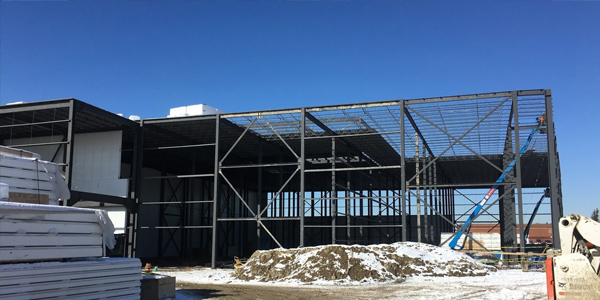
Sustainability requirements vary by project, procurement policy and certification target. Steel can support reuse and recycling strategies, but its environmental performance should be assessed using project-specific information.
Structural steel stands at the forefront of this green revolution. Often perceived as a heavy industrial material, steel is actually one of the most sustainable and “circular” building materials available today.
1. 100% Recyclability: A Circular Economy
Unlike concrete, which often ends up in landfills after demolition, steel is the most recycled material on the planet.
Infinite Lifecycle: Steel can be melted down and repurposed infinitely without losing its structural integrity.
- Recycled content: Request the producer’s environmental product declaration or material information for the actual steel supply. Do not assume one recycled-content percentage applies to every product.
2. Reducing Construction Waste
Traditional construction sites often produce massive amounts of waste due to on-site cutting and errors. Metal fabrication changes that:
Off-Site Precision: At our fabrication shop, we use advanced software to nest parts perfectly on a single sheet or beam, minimizing off-cuts.
- Site waste: Shop preparation can reduce site cutting and off-cuts, although material waste and transport impacts still need to be managed.
3. Speed of Construction and Energy Efficiency
Sustainability also relates to how efficiently a project is completed.
Lower Carbon Footprint: Faster construction times mean fewer months of heavy machinery running on-site, lower fuel consumption, and less disruption to the local ecosystem.
Integration with Insulation: Modern steel framing allows for the easy installation of high-performance “thermal break” insulation. This reduces the energy required to heat and cool buildings during Ontario’s extreme seasonal temperature swings.
4. Adaptability and Building Longevity
The greenest building is the one that doesn’t need to be torn down.
Future-Proofing: Steel structures are uniquely adaptable. If a commercial building needs to be converted into residential lofts 20 years from now, steel beams can be reinforced or modified far more easily than reinforced concrete walls.
Longevity: With proper finishes like hot-dip galvanizing, a steel structure can last over 100 years, drastically reducing the need for new raw materials in the future.
5. Contributing to LEED Certification
LEED and other rating systems: The contribution of steel depends on the applicable scheme, product documentation and whole-project assessment. Using steel alone does not guarantee certification or a financial incentive.
Materials and Resources: Due to high recycled content and regional sourcing.
Waste Management: Thanks to the precision of the fabrication process.
Innovation in Design: By allowing for larger windows (maximizing natural light) through long-span steel beams.
Conclusion: Building for the Next Generation
Choosing structural steel is an investment in both your property and the environment. At Weld Rich & Steel, we take pride in being part of a sustainable supply chain that supports Ontario’s green building goals. By combining high-strength steel with precision fabrication, we help you build structures that are safe, durable, and ecologically responsible.
Plan Your Next Project
Explore our commercial structural steel fabrication services and read the related project guide. For a scope review, send your drawings or photographs, project location and required fabrication or installation work.