
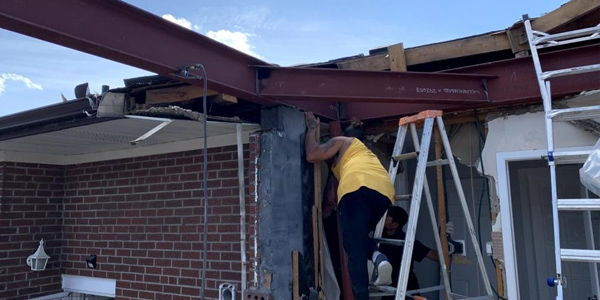
In structural steel fabrication, there is no “one-size-fits-all” welding method. The choice of process affects everything from the speed of construction to the structural integrity of the joint in extreme weather. At Weld Rich & Steel, our CWB-certified technicians are experts in several key welding processes, each selected based on the project’s specific engineering requirements.
Understanding these processes helps project managers and homeowners understand why a certain technique is chosen for their site or shop-fabricated components.
1. GMAW (Gas Metal Arc Welding) – Commonly Known as MIG
GMAW is the standard for high-speed, high-quality fabrication in a controlled shop environment. It uses a continuous solid wire electrode and a shielding gas (usually a mix of Argon and CO2) to protect the weld pool.
Best for: Indoor shop fabrication of beams, custom staircases, and stainless steel components.
Advantages: Extremely clean welds with very little slag. It allows for high productivity and deep penetration in thick structural steel.
Limitation: Cannot be used outdoors in windy conditions, as the wind will blow away the shielding gas, leading to porosity (weakness) in the weld.
2. FCAW (Flux-Cored Arc Welding)
FCAW is often considered the “big brother” of MIG welding. It uses a tubular wire filled with flux. As the wire melts, the flux creates its own protective gas and slag layer.
Best for: Heavy structural steel erection and on-site welding.
Advantages: Highly portable and much more tolerant of wind than MIG. It is excellent for thick plates used in industrial frames and heavy-duty lintels.
Why we use it: It provides high deposition rates, meaning we can complete large structural joints faster without sacrificing strength.
3. SMAW (Shielded Metal Arc Welding) – Commonly Known as Stick
This is the most traditional and versatile form of welding. It uses a consumable electrode (stick) coated in flux.
Best for: Outdoor repairs, mobile welding in Toronto’s winter, and hard-to-reach structural joints.
Advantages: It is the most “rugged” process. It doesn’t require gas tanks and can weld through minor surface rust or paint (though we always clean surfaces for CWB-level quality). It is the go-to for on-site emergency repairs.
Why it matters: When we are performing mobile welding on a rooftop or in a tight alleyway, SMAW ensures a code-compliant weld regardless of the environment.
4. MCAW (Metal-Cored Arc Welding)
A high-efficiency variation that combines the benefits of MIG and Flux-Core. It uses a metal-filled tubular wire.
Best for: Large-scale commercial projects requiring high-volume fabrication.
Benefits: It produces almost no slag and very little spatter, reducing the time needed for “finishing” and cleaning before painting or galvanizing.
5. How We Choose the Right Process
At Weld Rich & Steel, the selection process is governed by the Welding Procedure Specification (WPS) approved by the CWB. We consider:
Environment: Is the work in our shop or on a windy construction site?
Material Thickness: Thin-gauge architectural metal vs. 1-inch thick structural beams.
Position: Is the weld being done on a table (flat) or overhead on a bridge support?
Aesthetics: Does the weld need to be perfectly smooth for a visible staircase, or is it a hidden structural joint?
Expertise You Can Trust
A CWB-certified company doesn’t just “weld”—it applies the correct science to ensure the safety of the structure. By mastering these diverse welding processes, Weld Rich & Steel provides Ontario clients with a guarantee that every joint is engineered for maximum performance.