
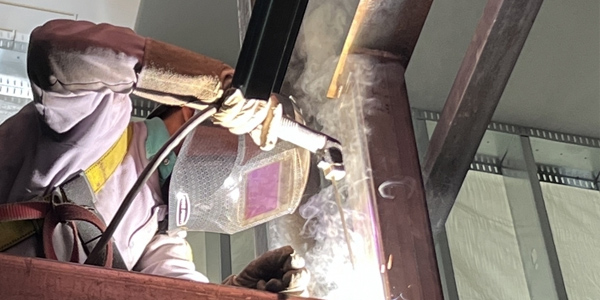
In the Greater Toronto Area, the construction season is no longer restricted to the summer months. As developers push for year-round progress, structural welding in extreme environments—specifically during a harsh Canadian winter—has become a standard requirement. However, welding at -20°C is not the same as welding at +20°C. If not handled by CWB-certified experts, cold-weather welding can lead to catastrophic structural failure, delayed inspections, and massive legal liabilities.
At Weld Rich & Steel, we’ve mastered the specialized engineering protocols required to deliver shop-quality welds in sub-zero conditions. Here is a deep dive into the science, the risks, and the solutions for structural welding in the Ontario frost.
1. The Science of Cold Cracking: The Invisible Enemy
The single greatest danger of welding in the cold is Hydrogen-Induced Cracking (HIC), often referred to as “cold cracking.” This phenomenon occurs when hydrogen atoms get trapped in the crystalline structure of the weld.
The Source of Hydrogen: In winter, snow, ice, or even invisible condensation on the steel turns into hydrogen gas the moment the welding arc strikes.
The Cooling Trap: In freezing temperatures, the surrounding cold metal acts as a “heat sink.” It pulls heat away from the weld pool so rapidly that the metal transforms into a brittle state known as Martensite.
The Result: The trapped hydrogen exerts internal pressure, and because the metal is brittle, it cracks—sometimes hours or even days after the weld was completed. This is why “delayed cracking” is the nightmare of structural inspectors.
The Weld Rich & Steel Solution: We follow strict Pre-Heating Protocols. Using specialized infrared thermometers and propane torches, we raise the temperature of the steel at the joint to at least 10°C to 100°C (depending on the thickness of the steel and the grade). This evaporates all moisture and slows down the cooling rate, allowing the hydrogen to escape safely.
2. Managing the “Heat-Affected Zone” (HAZ)
When you weld, you aren’t just melting the joint; you are changing the properties of the steel around the joint—the Heat-Affected Zone. In extreme cold, this zone is prone to becoming hard and brittle.
The Risks of Rapid Quenching: If the air is freezing, the weld is essentially “quenched” (cooled instantly). This destroys the ductility of the steel, making the beam susceptible to snapping under vibrational stress or heavy snow loads.
Post-Weld Heat Treatment (PWHT): On critical structural joints, we don’t just stop when the weld is done. We utilize thermal blankets or insulation wraps to slow down the cooling process. By controlling the temperature drop over several hours, we ensure the joint remains flexible and strong.
3. Equipment and Consumable Selection for Sub-Zero Work
Standard welding setups fail in the cold. Shielding gases like Argon or CO2 can struggle to flow correctly, and the gas lines themselves can become stiff and crack.
Process Selection: While MIG (GMAW) is great in a shop, it’s often unreliable on a windy Toronto construction site. At Weld Rich & Steel, we often pivot to FCAW (Flux-Cored Arc Welding) or SMAW (Stick Welding) for extreme environments.
Low-Hydrogen Electrodes: We use specialized consumables, such as E7018-H4R electrodes. These are designed specifically to minimize hydrogen levels in the weld deposit and are stored in portable ovens on-site to keep them bone-dry.
Autonomous Mobile Units: Our trucks carry high-output generators that can handle the increased voltage drops caused by cold weather, ensuring a stable, high-penetration arc at all times.
4. Compliance with CSA W59 and Ontario Building Codes
In Ontario, structural welding is governed by the CSA W59 (Welded Steel Construction) standard. This code has very specific mandates for cold-weather work:
Mandatory Pre-Heat: No welding can be performed on steel colder than -18°C without approved pre-heating procedures.
Environmental Protection: The welding area must be shielded from wind and precipitation.
CWB Certification: Every technician must hold a valid ticket for the specific position and process being used.
Weld Rich & Steel doesn’t just meet these codes; we exceed them. We document our pre-heat temperatures and environmental conditions for every structural joint, giving General Contractors the peace of mind that their project will pass every engineering audit.
5. The Human Factor: Precision Under Pressure
Structural welding requires a steady hand and total focus. It is nearly impossible to maintain a 1mm tolerance when a welder is shivering.
Micro-Environments: We set up temporary heated enclosures or “welding tents” for critical on-site work. This protects the weld from the wind and ensures our CWB-certified welders can operate at their peak performance.
Trust the Experts in Extreme Engineering
Winter construction is a reality of life in the GTA, but it shouldn’t be a gamble. By choosing a partner who understands the material science of cold-weather welding, you protect your building, your budget, and your reputation.