
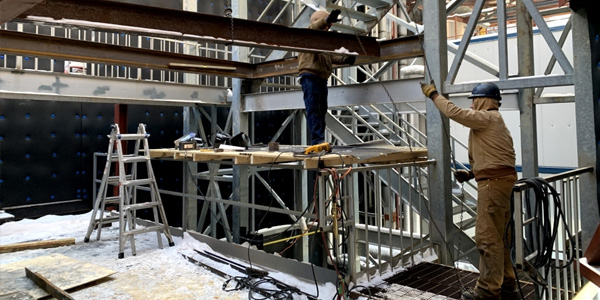
In the world of structural steel, a single faulty weld can lead to costly project delays or, in the worst cases, catastrophic structural failure. Understanding the most common welding defects is essential for project managers, inspectors, and fabricators to ensure the longevity of any construction project in Ontario.
Here is a technical breakdown of the most frequent structural welding mistakes and the professional methods used to fix and prevent them.
Porosity: The “Gas Pockets” Problem
Porosity occurs when gas becomes trapped in the weld metal during solidification, creating small bubbles or “pores.”
The Cause: Often due to contaminated base metal (rust, oil, or moisture) or inadequate shielding gas coverage during the FCAW or GMAW process.
The Fix: The affected area must be ground out to sound metal and re-welded.
Prevention: Proper pre-weld cleaning and ensuring a wind-free environment for on-site mobile welding.
Undercutting: The Weakened Edge
Undercutting is a groove melted into the base metal next to the weld toe that is not filled by the weld metal.
The Cause: Excessive current (amperage) or improper welding technique/angle. It effectively thins the structural beam, creating a point of stress concentration.
The Fix: Depending on the severity, it requires adding a small stringer bead to fill the groove and restore the metal’s thickness.
Prevention: Using the correct travel speed and ensuring the welder is properly qualified for the position.
Incomplete Fusion and Penetration
This happens when the weld metal doesn’t fully fuse with the base metal or doesn’t reach the root of the joint.
The Cause: Insufficient heat input or improper joint design (groove angles that are too narrow).
The Fix: This is a critical defect. The weld must be completely removed (gouged or ground out) and the joint must be re-prepared and re-welded.
Prevention: Strict adherence to Welding Procedure Specifications (WPS) and proper beveling of thick steel plates.
Slag Inclusions
Slag inclusions are non-metallic solids trapped in the weld metal, common in SMAW (stick) and FCAW (flux-cored) processes.
The Cause: Failure to properly clean the weld between passes in multi-run joints.
The Fix: Grinding out the inclusion until clear metal is visible, followed by a new weld pass.
Prevention: Rigorous wire brushing and chipping of slag after every single pass.
Cracking (The Most Serious Defect)
Cracks can be “hot” (occurring immediately) or “cold” (occurring hours or days later).
The Cause: Rapid cooling, lack of preheating on thick steel, or hydrogen embrittlement.
The Fix: Cracks generally require a full engineering review. The weld must be removed far beyond the visible ends of the crack and re-done with strict preheating protocols.
Prevention: Following CSA W59 preheating requirements and using low-hydrogen electrodes.
Why Professional Inspection is Vital
Many of these defects are “sub-surface,” meaning they are invisible to the naked eye. This is why Weld Rich & Steel emphasizes:
CWB Certified Supervisors: To catch technique errors in real-time.
Non-Destructive Testing (NDT): Utilizing Ultrasonic or Magnetic Particle testing for high-load connections.
Need a structural audit? If you are concerned about existing steelwork, our Mobile Welding Services include on-site inspection and repairs.
FAQ: Welding Defects & Repairs
Can a “bad-looking” weld still be structurally sound?
While aesthetics don’t always equal strength, a messy weld often indicates poor technique, which usually correlates with internal defects like slag inclusions or lack of fusion.
How much undercut is allowed in structural steel?
According to CSA W59, the allowable undercut depends on the thickness of the material and whether the load is transverse or longitudinal. Generally, anything over 0.5mm – 1mm requires a closer look.
What is the most expensive defect to fix?
Cracking. It often requires not just a re-weld, but also specialized heat treatment and third-party NDT testing to ensure the integrity is restored.