
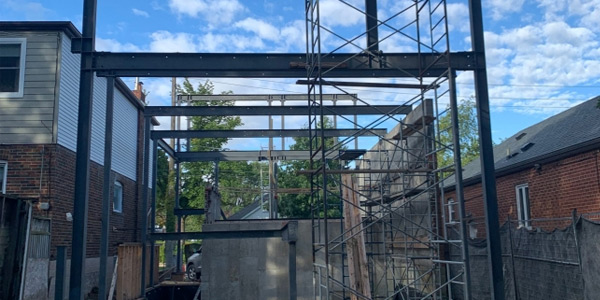
When starting a construction project in the GTA—whether it’s a custom modern home or a commercial warehouse—the first major decision is the structural system. Understanding the difference between a Load-Bearing Structure and a Framed Structure is critical for determining your project’s cost, speed, and future flexibility.
At Weld Rich & Steel, we work with both systems, providing the structural steel components that make these buildings possible. Here is a breakdown of how they work and which one suits your needs.
1. Load-Bearing Structures: The Traditional Approach
In a load-bearing system, the walls themselves support the weight of the entire building (roof, floors, and occupants) and transfer it down to the foundation.
How it works: Think of a traditional brick house. Every exterior wall (and some interior ones) is essential. If you remove a wall, the floor above may collapse.
Materials: Typically masonry (brick/block), stone, or heavy timber.
The Role of Steel: Even in load-bearing buildings, steel is essential. We fabricate lintels and header beams that allow for windows and doors to be cut into these thick walls without compromising the structure.
Pros:
Cost-effective for small, simple residential buildings.
Excellent fire resistance and sound insulation due to thick walls.
Cons:
Zero Flexibility: You cannot easily move walls for an “open-concept” renovation.
Height Limits: As the building gets taller, the bottom walls must become incredibly thick, wasting valuable floor space.
2. Framed Structures: The Modern Standard
A framed structure works like a human skeleton. A “cage” of vertical columns and horizontal beams supports all the weight. The walls are merely “curtains” that keep the weather out but carry no load.
How it works: Heavy-duty steel columns and beams are bolted or welded together. This skeleton carries the entire load of the building.
Materials: Structural steel is the premier choice for framing due to its strength-to-weight ratio.
Pros:
Complete Flexibility: Since the walls aren’t holding anything up, you can place them anywhere—or have no walls at all (glass facades).
Speed: Steel frames are fabricated in our shop and “erected” on-site in days, not weeks.
Space Efficiency: Thinner walls mean more square footage for living or working.
Cons:
Higher initial material cost compared to basic masonry.
Requires specialized CWB-certified welding and professional engineering.
3. The Comparison: Side-by-Side
| Feature | Load-Bearing Structure | Framed Structure (Steel) |
| Load Transfer | Through walls to foundation | Through beams/columns to foundation |
| Design Freedom | Limited (Small rooms) | Infinite (Open concept) |
| Construction Speed | Slower (Brick by brick) | Fast (Pre-fabricated steel) |
| Renovation Potential | Difficult/Expensive | Easy (Walls can be moved) |
| Best For | Low-rise residential | High-rise, lofts, modern homes |
4. Converting Load-Bearing to Framed: The Toronto Trend
Many of our projects in downtown Toronto involve converting old load-bearing masonry homes into modern framed spaces.
The Steel Intervention: We install massive structural steel beams (I-beams) to replace old load-bearing walls.
The Result: We effectively turn a rigid, “closed-off” Victorian house into a modern framed structure, allowing for the wide-open kitchens and living areas that drive up property values.
Choosing Your Foundation
If you are building a simple shed or a small traditional cottage, load-bearing walls might suffice. But if you want a building that is future-proof, open, and fast to build, a structural steel-framed system is the undisputed winner.